 Albuquerque Public Schools
2025 October Wellness Newsletter
Getting the most out of your benefits, picking up where we left off with the four wellsprings of energy management, ComPsych to help you navigate the peaks and valleys this season, and more wellness trends in the news.
Wellness Wire: Switchbacks & Undulating Terrain
I’ve been percolating on this one for a while. During hobbled trail runs through the summer, into this moment where we approach the ‘official’ holiday season.
Truth is, my life from May to now has been a bit like an unpredictable, undulating trail. While I’ve experienced incredible peaks and breathtaking views with both of my children and husband. I’ve also lugged uphill through injury and health struggles and pushed past switchbacks of grief from the sudden death of my twin brother.
Injuries, illness, and loss can derail our best efforts. Mourning has a way of draining motivation. If you don’t feel “well” physically, emotionally, mentally, or spiritually, you don’t feel much like doing anything at all. Discipline, conviction, a bit of grace, and faith became my pillars to lean on when motivation wasn't showing up.
It occurred to me that life and the intersection of our well-being can feel like a series of switchbacks and undulating terrain.
We started this year with the theme: “Thrive in 2025 to reclaim health and harmony.” We identified Growth Goals in our spiritual, social, and intellectual wellness to pair with the four well-springs for energy management. To thrive in life and experience connectedness and harmony, we need goals that expand our personal or professional development, deepen our connections with others, and a sense that we can blend this with our meaning, purpose, and passions to serve a greater good.
Goals, however, take energy. There's an interplay between physical, mental, emotional, and spiritual well-being. Mental stress and emotional fatigue are physically exhausting. Spiritual disconnection from our purpose, serving others, and community drains our emotional reservoirs. The truth is, we need steady energy across all four areas to thrive. We’ve spent this whole year defining and laying the foundations for physical, emotional, and mental energy, and we're now heading into the spiritual wellspring for sustainable energy management.
Switchbacks & Pivots
If you've ever been hiking, biking, or running on trails, you know they aren't straightforward. Often, we have switchbacks to navigate steep terrain, which also give us a change in direction.
Now, from a running standpoint, this isn't bad; it helps us in the climb. But if we're not prepared for lateral shifts and pivots, it can trip us up. (Literally and figuratively, trust me, I've experienced that on trails, too!)
We have switchbacks—changes in direction—every single day. With personal and professional situations, this can be a source of frustration, I know. But let's think of a switchback as a pivot opportunity and absorb the impact by using quick-twitch emotional fitness muscles rather than a rigid stance. This way, we navigate changes more resiliently.
Instead of being brittle with unexpected changes - the kid who woke up sick, the meeting that didn't go as planned, a tense communication exchange with a colleague, traffic that made you late - situations that cause frustration, stress, and tax our mental and emotional energy- we can proactively pivot with reframing strategies and purposeful pauses to reset and realign our path.
We can also think of switchbacks as making a change in the right direction when we're headed down the wrong path. Sometimes we languish on flat roads, not making progress in our goals, or take on habits with food, alcohol, or internet binging that deteriorate our health and diminish emotional and mental wellness.
In all areas of our lives, to grow and expand our intellectual, spiritual, social, and emotional well-being, we have to be willing to pivot and change direction. We all have the capacity to bend the trajectory of stress and illness toward peace and wellness. But we have to adjust our expectations around situations, absorb with a lateral shift. And, when daily life circumstances change, we can train our emotional fitness muscles to adapt without compromising our well-being.
Undulating Terrain & Pacing
Think beautiful roller coaster-like hills with a few flat areas to catch your breath, then swooping switchbacks carrying you up in elevation again. It can be invigorating to run—yes—but tiring if we’re not pacing ourselves. We approach our work—a new school year or semester—like we might hills: quickly, at a pace we can't reasonably sustain for the duration. Without proper pacing, we burn out before the finish line. You know that feeling; you may be in it right now.
The thing about something that “undulates” is - it’s hard to find a consistent rhythm. Because it’s always moving, shifting, changing. As humans, we tend to like consistent terrains. We intentionally build predictable schedules and want to stick to them. That scheduling and staying on task, feeling productive, helps our mental energy wellspring.
Life doesn’t work that way, though, does it? It’s not predictable, and a sudden terrain change has a way of chucking consistency and productivity out the window. We can have days, weeks, and seasons of unpredictable undulation, and this is challenging to navigate, not just physically, but these seasons are emotionally and mentally draining. It causes stress and uncertainty. If we think we can’t traverse the terrain well, we may give up and check out. No one likes to feel like a failure, like there's no hope, it's too hard, too much work, or not enough support - this leads to 'quiet quitting' - the insidious workplace moral killer where there may be warm bodies but people have "checked out" and offer no meaningful engagement.
The extra output required to navigate unexpected terrain changes drains our energy. In the mental energy wellspring, we framed it as workday obstacles. Whenever something doesn’t go as planned, it is distracting and stressful. It can cause frustration, anger, and hurtful outbursts. The unexpected is always hard to absorb. It can easily send us to our knees, especially if we’re fatigued from what we just climbed. We don’t self-regulate well when we’re emotionally taxed, mentally drained, and physically tired. We can maneuver this better when we practice situational awareness-paying attention to internal and external cues, proactively adapt, and plan for what we can control, and practice intervals of work and rest.
Life isn’t a sprint, so slow down. Tackle new hills, days, weeks, or projects with care - scan and evaluate the landscape you can see, walk first, take deep breaths, fuel properly, and pace your physical, mental, and emotional energy.
Shadows & Hidden Obstacles
Have you noticed sunlight filtering through a canopy of trees? It is beautiful, but if you’re running on a trail (trotting, shogging, or hiking), it can be a bit treacherous because there’s not a steady source of light. It’s dispersed and unbalanced. You might feel that way with your wellness and growth goals this year. I know I have!
Without a steady source of light guiding our way, our depth perception is limited, and we can trip over hidden obstacles. You know the type: habits that hold us back, self-defeating thoughts, and behaviors.
That light source is our spiritual wellspring. This wellspring relates to developing a personal "value-based why", a sense of connection and belonging to nature or a higher source, cultivating meaning and purpose, serving others, and the greater good.
The overarching idea with our spiritual energy wellspring is, "Who do you want to be, what do you want to reflect, and how do you want to show up in the world?"
Spirituality is the anchor to the other three wellsprings and gives us conviction when motivation wanes.
When our physical and emotional strength are tapped and we feel like acting out, folding in, or giving up, our spiritual wellspring rises and says, "No, this isn't who I am, how I want to be, or what I want to reflect." So we muster up, move through or step over the obstacle, give ourselves a gratitude talk, and keep going.
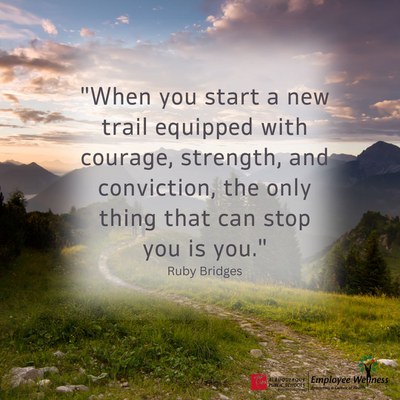
As the graphic above suggests, once you commit to a new trail (habit, day, season, semester, year) and gather courage, strength, and conviction, the only thing that can stop you is you.
If we're not paying attention to the societal river of stress, depression, and anxiety borne out of complacency and life dissatisfaction, we will stumble on the switchbacks. We'll fatigue and grow weary of maneuvering rocky terrain. Shadows of hurt, loss, resentment, ego, pride, or anger eventually will take us down in one way or another.
The good news is we all have a choice on this trail called life. We get to choose:
- What we eat or don't eat.
- What we drink or don't drink.
- If we move or don't move.
- How we spend our spare time.
- What we watch or don't watch, read or don't read. Your choice.
- How we spend our time and who we spend it with
- What we feed our hearts, minds, and souls.
- To let a bad morning, meeting, or interaction define our mood for the day, or not:)
- Our work, profession, vocation... yeah...especially in this day and age, you can choose not to stay stuck in a place you don't belong.
My encouragement to you is this: Our journey can take us to wonderful places and joy-filled times. We will also face rocky terrain and uphill battles through shadows of doubt, illness, and fear. We may, at times, get lost and lose our way. Our spiritual well-being is that internal and eternal light that can show us the way when our inner compass falters or shuts down. But not starting means we've already chosen to fail. It may sound harsh, but it's really that simple.
As we saunter into November and December, join the Thrive in 2025 November activities, identify your 'value-based why', and hone in on elements of the spiritual wellspring that can become a guiding light for our physical, mental, and emotional well-being now and in the future.
Join November Thrive Activities!

As mentioned above, the spiritual wellspring for energy management is the anchor that holds our physical, mental, and emotional energy together when we face seasonal or situational highs and lows.
Spirituality can be defined "as the way people express meaning and purpose, experience connectedness to the moment, to self, to others, to nature, and to the significant or sacred." (Journal of Palliative Medicine)
There has been a growing call to address spirituality in the workplace and its connection to mental health and workplace well-being is undeniable. We will be unpacking the research and data in the November Wellness Newsletter, the APS Employee Wellness calendar, and throughout the focus activities listed below.
November Focus Activities:
- Nov. 3-9: Defining spiritual wellbeing in the workplace & discovering your meaning, purpose, and value-based “why”.
- Nov. 10-16: The Power of Practicing Gratitude
- Nov. 17-23: Social Connection
This is a yearlong program that offers flexibility to participate in various activity challenges, nutrition resets, education, short videos, and wellness journeys.
- The year is structured into four quarters for the wellsprings of "energy management."
- Activities and challenges will center around physical, emotional, mental, and spiritual well-being.
- Everything is hosted on the Wellness at Work well-being platform, and information is duplicated on the APS Employee Wellness event calendar.
*Invites for these weekly focus activities and other challenges go out through the APS Employee Wellness group on Wellness at Work. See below.
Simple steps to participate:
If you haven't already done so, join the Wellness at Work wellness incentive platform.
- Join the APS Employee Wellness group. (Click "social" and browse "groups," find the APS Employee Wellness group, and join to receive invitations to nutrition reset activities, "sugar-free me" cleanse, kitchen-clean up, movement challenges, stress, and burnout-busting activities, and so much more!)
- Under "Social," click "Events Calendar." Browse and read the information daily or weekly. The information is also duplicated in the APS Employee Wellness event calendar.
- Earn wellness incentive points for rewards and ongoing gift card prizes for participation throughout the year! (Gift card prizes are in addition to your wellness incentive point rewards.)
- Please join the "APS Employee Wellness Group" on the Wellness at Work platform to participate in challenges and be eligible for additional raffle prizes. This step ensures you receive invitations to join challenges when they arise. You can also pick and choose which challenges to participate in throughout the year.
Tips To Get The Most Out Of Your Healthcare Benefits

The lights have officially dimmed on this year's Open/Switch Enrollment, "Your Benefits-Illuminated." If you missed some of the online information to help shine the light on your health benefits, wellness resources, and general medical consumerism savvy, don't fret! Keep reading below for easy ways to get the most out of your benefits.
This is the time of year when stress and expenses are on the rise, but let's face it, there's never a good time for an unexpected bill. We know the healthcare system is a labyrinth waiting to be solved, but in the meantime, there are several things you can do to make your experience navigating the medical maze a little easier and less expensive.
- Log in and surf your medical, dental, vision, and pharmacy (Express Scripts) member portal. Download the mobile apps for quick access. Click here for APS-specific medical, dental, vision, and pharmacy sites.
- Through your health plan member portal, check out and create accounts for your medical and dental virtual/telehealth platforms. The last thing we want to do when we're in a crisis, feeling sick, or dealing with a sick loved one, is to have to figure out virtual or telehealth benefits. Get familiar with your health plan's virtual offerings. Then you'll be ready to go if and when you need the services!
- Also in your member portal are cost estimator tools for services, medical procedures, and places of service/facilities. This is a great expense-reducing resource to use before booking appointments and procedures.
- Use the "find a provider" tool for medical professionals in your area who meet your preferences for experience, ratings, location, and other expectations.
- The ER and Urgent Care aren't always the best options for every medical circumstance. Know where to go by using this guide.
The healthcare industry touts a $4.5 trillion expense annually on the American public. Remember, we all pay into this system. Ninety percent of these costs are from preventable chronic illnesses. Prevention is the only way to curb this trend, and we can do this by knowing resources, being smart consumers, and being proactive in our pursuit of physical, mental, and emotional well-being.
If you have questions about your benefits, email the Employee Benefits Department at employee.benefits@aps.edu. For wellness resources, contact employee.wellness@aps.edu. Click here for the Benefits staff listing.
Energy Management & Our Not So Secret Sustainability Problem
Originally posted Oct. 2024 - The sustainability concept for employees is what initiated the concept for the APS Thrive in 2025 year to reclaim health and harmony centered around the four wellsprings for energy management. We have the opportunity to thrive or decline and wither on the vine. What's it going to be?
"It's unsustainable." That’s the phrase I hear time and time again from employees, administrators, and people in high-stress, overwhelmed positions where there are unrealistic expectations, no breaks, or boundaries. Considering the vital role all of our employees play- teachers, principals, assistant principals, deans, executive directors, and the vast support services throughout the district, that's just devastating. But don't feel bad, it's not just our district or industry feeling this way. This is a common sentiment from employees in multiple workforce sectors.
My response to that comment is - you're right. If we keep approaching work and life in the same way, we'll have the same outcome - unsustainability leading to burnout, high rates of absenteeism, leaves, and departures. So something has to change.
One may argue that our physical environment is declining but we know for sure the well-being of the human race is plummeting. This is reflected in our health care costs, the rise in mental health struggles, substance overuse disorders, and other preventable chronic illnesses I highlighted in the last Wellness Wire "Reclaiming What's Lost."
The bottom line is America has a sustainability problem, but not in the way we generally think of the environment. Typically, sustainability in the workplace is reflected in a commitment to greener practices like recycling, using less water, reducing our carbon footprint, and conserving natural resources.
For our purposes, let's shift the perspective to the sustainability of human well-being and the idea that employees are the greatest natural resource of any organization.
I want to emphasize the importance of the conservation of our emotional, mental, and physical well-being so that our workplace, and the jobs we step up to every day, are sustainable in the context of the whole - our life purpose, connection, family time, the capacity for self-care, and expansion in other areas of life (not just work).
If something is 'unsustainable', it's defined as "not able to be maintained at the current rate or level; not capable of being prolonged or continued."
If someone feels a situation is not sustainable, what they're really saying is they can't do it or the toll it's taking on them to do the job is too much. We can all sense pressure-induced cracks. We don't feel successful, things are slipping, balls are dropping, and no one - NO one- likes to feel that way. It diminishes our intellectual and emotional well-being, which then affects all other areas of our wellness, including personal and professional relationships.
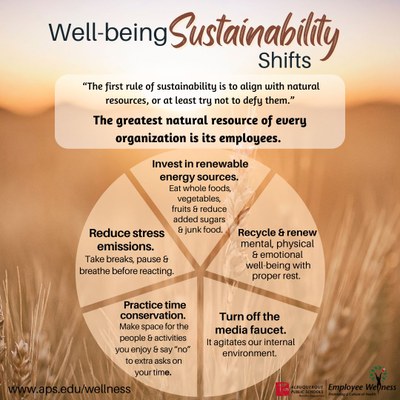
I read a quote that said, “The first rule of sustainability is to align with natural resources, or at least try not to defy them.” If our most precious natural resource is us (humans), then we need to stop defying what aligns with nature and honor our basic safety and psychological needs. Also, if we're considering any situation as "sustainable" or "unsustainable", we're still comparing it to the context of the bare minimum - surviving, not thriving.
The wellsprings of energy are not infinite. Physical, mental, emotional, and spiritual well-being must be renewed daily. In our current workplace and life dynamic, that's not happening.
A 2023 article in Investopedia states it like this: “In the broadest sense, sustainability refers to the ability to maintain or support a process continuously over time. In business and policy contexts, sustainability seeks to prevent the depletion of natural or physical resources, so that they will remain available for the long term.” I think many of us would agree that we want our employees, friends, and family to remain at APS, be actively involved in the community, and flourish over the long term. To do that, we have to invest in human sustainability.
When "the system", with all its redundancy and unpredictable crises that we don't have control over, is a Goliath that may take years to fix, the only solution is to shift how we view sustainability and our lifestyles. This is how we approach and tackle our not-so-secret sustainability problem. Sure, business systems everywhere could do an audit to trim and scale back or hire and build in areas that need it. But that takes a willingness to take on a heavy re-organization lift. That's not easy when resources on all levels (time, money, and human capital) are strapped.
And much of that, if not all, is out of our control. What we can control, are the things within our sphere of influence. Like our time, boundaries, and realigning expectations. We can control what we eat and drink, our movement, and our mindsets.
Just like environmental conservation advocates for small changes over time that have a massive impact, we must look at the reclaiming of human well-being in the same light. Small changes over time equal a big impact.
So, it's time we go green on our emotional, mental, and physical well-being once and for all. Some would say "The choice is yours." But I say, given what's a stake, is there really a choice?
Here are some concepts for well-being sustainability:
- Willingness to change a not-so-comfortable norm that we've been made to believe is 'the norm'. It's not normal to work 10-12-14 hour days on the regular. It's not normal to languish in a sleep-deprived environment. It's not normal to live a sedentary lifestyle. Sugary drinks and highly processed foods are not normal for our body's design, which is why we're getting sick, have low energy, and obesity as a preventable chronic health condition. (FYI- before 2013, this was not on the CDC list.)
- Turn off the media faucet. Not only can the media scroll and Netflix binging waste time when we could be exercising, engaging in a hobby, or sleeping, but it's also an agitator. Social media can rub our internal environment the wrong way, causing angst, frustration, conflict, and outward anger. Turn it off. Read something uplifting or go to bed instead of sacrificing rest and emotional well-being.
- Reduce stress emissions
- Recycle - We need true rest and recovery We also need to advocate for it on every level - leaders included. No one is immune to disease, so why should you tell everyone else to rest while your battery is completely depleted?
- Engage in true natural resources and renewables. Get outside. Spend time in the sunlight, breathe fresh air, walk, hike, bike. New Mexico is one of the most beautiful states and we have so much in our backyard to enjoy. Try adding more natural, whole foods to your diet and limit added sugar and processed foods.
- Make an Alternative Energy Shift: Our district has undertaken a massive project and adopted goals and guardrails that will raise student scores and overall outcomes. The needle is moving in the right direction, which is great! Let's keep the needle moving in the right direction for sustainable well-being, too. We will not realize any goal if our focus isn't also aligned with employee mental, emotional, and physical sustainability and well-being. We can't expect the people who are given the task to get the kids engaged and succeeding if they are struggling themselves.
This is the critical sustainability shift I want to highlight. Employees are our most valuable resource. Let's take the time to invest and advocate for everyone's well-being and value energy management concepts. Is this a heavy lift? Yes. Like most worthy causes, cultivating our well-being for long-term sustainability may not be easy, but we owe it to ourselves, our families, and the collective good. We will eventually see the reversal of all negative trends in workforce absenteeism, burnout, leaves, preventive chronic illnesses, mental health decline, and education shortfalls. More importantly, we'll experience life the way we are intended - with less illness and stress, more joy, mobility, purpose, and connection.
We know getting started with any change is the hardest part. APS Employee Wellness offers an integrated suite of well-being solutions, including free health coaching for lifestyle changes, Hinge Health for pain, injury, strength, and mobility issues, Livongo for weight loss, diabetes and blood pressure, free mental health care, and more. Check out all your resources www.aps.edu/wellness.
Wellness Wire: Reclaiming What's Lost
More Wellness Trends In The News
|


