 Albuquerque Public Schools
August "Thrive in 2025" Employee Wellness News!
It's back-to-school and time to thrive with employee wellness activities! What is mental energy? Check out the *New* APS Employee Assistance Program (EAP), Youth on Mindfulness options, and more wellness trends in the news.
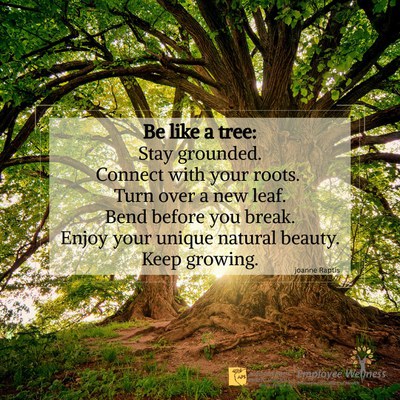
Wellness Wire - Be Like A Tree
I’ve written in the past about my non-negotiables for well-being. The daily routines that I absolutely need to maintain steady energy and keep me grounded.
We know what it's like to be pulled from our roots in today's world. Major life events, death of loved ones, conflict, or an unfortunate/unexpected diagnosis can rip our well-being out from under us in an instant. Or, little daily stressors wear on our mental and emotional energy, our internal compass severs bit by bit, and before we know it, we are like a leaf in the wind - blowing aimlessly about, with flip-flopping habits. At the mercy of situational and societal whims that might not reflect our goals, yet we’re susceptible to downward energy shifts all the same.
Let’s face it - life can feel chaotic. If we aren't anchored in habits that keep us grounded spiritually, physically, emotionally, and mentally, then it is chaotic because we're easily swayed and uprooted from the routines that provide steady, stable energy.
Which is why it’s essential (especially at the start of a new school year) to be like a tree - grounded, nourishing our roots, and staying connected to community and our growth goals to thrive!
Here are some interesting facts about trees and how they relate to our well-being:
Symbiotic Relationships
Trees have a symbiotic relationship with fungi and form mycorrhiza networks. This fungus network is the link that bonds the tree roots. This interconnectedness provides numerous benefits to trees, including increased resilience to stress, improved survival rates, and enhanced overall forest health.
Communication
Through these deeply connected root systems, trees can actually communicate warning of drought, pests, and other environmental stressors. (Very cool, I know, that’s an AI-generated statement, so let’s hope it’s accurate.)
“By sharing resources and information, trees enhance their collective ability to adapt to environmental stressors and defend against threats.” (Google AI)
Connection
The fungi-aided system fosters connections with trees of the same and different species. I think that’s cool. No silly judgments or bias, let’s just connect and support one another.
I know, you may be thinking “Ew -fungus!” We tend to think of fungus as bad, but in this instance, mycorrhiza networks are the lifeline for trees to connect, share resources, and communicate. We need systems like this, too.
Just like trees, we need reciprocal relationships and deep connections with others to bolster our health and resilience. Right now, between 33- 52% of adults in America experience loneliness, and 80% of youth under the age of 18 report feeling lonely. It’s been widely reported that loneliness is an epidemic in the US. This increases the risk of heart disease, type 2 diabetes, depression, anxiety, cognitive decline, dementia, and premature death. Those who experience higher rates of loneliness also tend to have a lower immune system due to the higher rate of stress hormones circulating in their bodies.
When we’re not communicating, connecting, sharing resources, and fostering symbiotic relationships, we are fundamentally weakening our individual and collective health and well-being.
Wellness is a group effort. A collective relationship that enhances the life experience for everyone!
Organizations and leaders that advocate this have employees who thrive because they prioritize realigning cultural goals that highlight the value of relatedness and belonging. Absenteeism goes down, productivity and collaboration go up, and well-being soars.
But here's the truth: We're not always going to like or get along with everyone we work with. We will always have interpersonal conflict and misunderstandings with colleagues. We're human. It's inevitable. Diseases by way of gossip, miscommunication, assumptions, and stress infest and weaken our cultural roots.
That doesn't mean we disengage, act in unkind ways, be disrespectful, or disassociate from the whole. Recognize that we find our community and connection in a variety of ways, including where we work. After all, we spend 8+ hours a day together. It's a much more enjoyable experience when we find common ground and cultivate our workplace roots.
As we start the new school year and continue our quest to Thrive in 2025 by reclaiming health and harmony, my encouragement to you is to stay grounded and embrace steady energy by participating in the thrive activities below..
If you are returning to work, turn over a new leaf of expectation. Let go of any wrongs or perceived hurts from the past year. Be willing to forgive and bend a bit. Open lines of communication and recognize the unique natural beauty all around us.
Keep scrolling below for August APS Thrive in 2025 activities and stay connected through the APS Employee Wellness event calendar.
Thrive in 2025 with the Mental Energy Wellspring
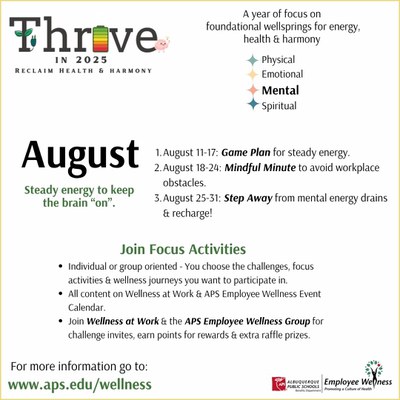
We began the year by laying the foundation for our physical well-being, focusing on energy management through a balanced approach to nutrition, regular movement, and adequate rest. Then, we transitioned into the emotional wellspring—the quality of our emotions through stress, anger, frustration, burnout, and interpersonal communication that sap our strength and lead to conflict, depression, anxiety, physical illness, and life languishing. In August and September, we'll focus on our mental energy wellspring and how our emotional and physical energy directly impacts our brains, communication, stress, and productivity.
What is the Mental Energy Wellspring?
The mental energy wellspring is characterized by our ability for productivity, such as prioritizing, task-shifting, scheduling, and concentration. But before any of that can happen, it's essential to know how the brain works in terms of mental energy.
Did you know that our brains are the most energy-demanding organ in the body?
The primary source of nutrients the brain uses is glucose, a sugar. But not the highly processed - donuts, cookies, and packaged food kind. 😏
For steady energy, we need complex carbohydrates like whole grains, beans & legumes, fruits, vegetables, healthy fats—such as nuts, olive oil, and lean protein.
According to a 2016 Harvard Medical School article:
"Brain functions such as thinking, memory, and learning are closely linked to glucose levels and how efficiently the brain uses this fuel source. If there isn’t enough glucose in the brain, for example, neurotransmitters, the brain’s chemical messengers, are not produced, and communication between neurons breaks down. In addition, hypoglycemia, a common complication of diabetes caused by low glucose levels in the blood, can lead to loss of energy for brain function and is linked to poor attention and cognitive function."
“The brain is dependent on sugar as its main fuel,” says Vera Novak, MD, PhD, an HMS associate professor of medicine at Beth Israel Deaconess Medical Center. “It cannot be without it.”
A wellness professional and researcher, Deb Smolensky, wrote a book titled "Brain ON". The book dives into the mental energy of the prefrontal cortex and how to build mental fitness.
- The prefrontal cortex is our rational, higher-thinking "On" brain.
- The amygdala is our emotional, reactive brain.
- Only one can operate at a time.
- The amygdala is our 'default' brain.
- When we are low on energy, fatigued, stressed, or just plain 'hangry,' our prefrontal cortex isn't as sharp and is less effective in regulating the amygdala. If left unattended, this becomes the "brain off" situation.
- This results in what is referred to as the "amygdala hijack" - When our rational brain is tired, over-taxed, and stressed, our amygdala, emotional brain, takes over.
- We're more apt to lose our patience and respond in anger or frustration. We end up doing and/or saying things we regret later.
- Inability to concentrate and focus is also a sign that our brain energy is low. When this happens, it's our cue to take a stretch or breath break, or to eat a nutritious snack.
How do we give our brains steady energy and avoid a "brain off" situation?
1. Eat balanced meals and whole-food snacks. Refer to these Precision Nutrition plate guides.
2. Take breaks! Even if it's just a 1-minute breathing hack, it can have a significant impact on your emotions, which resets mental energy. (See below for Aug. 18 focus activity week!)
3. Practice taking a purposeful pause.
4. Be aware of workplace obstacles and plan for what you can control.
Read below about focus activities on the Wellness at Work platform and how you can join and participate.
Focus Activities on Wellness at Work for August to Build & Keep Brain "ON" Status
- August 11-17: Game Plan for steady energy.
- August 18-24: Mindful Minute to avoid workplace obstacles.
- August 25-31: Step Away from mental energy drains & recharge!
Simple steps to participate in Thrive activities:
If you haven't already done so, join the Wellness at Work wellness incentive platform.
- Join the APS Employee Wellness group. (Click "social" and browse "groups," find the APS Employee Wellness group, and join to receive invitations to nutrition reset activities, "sugar-free me" cleanse, kitchen-clean up, movement challenges, stress, and burnout-busting activities, and so much more!)
- Under "Social," click "Events Calendar." Browse and read the information daily or weekly. The information is also duplicated in the APS Employee Wellness event calendar.
- Earn wellness incentive points for rewards and ongoing gift card prizes for participation throughout the year! (Gift card prizes are in addition to your wellness incentive point rewards.)
- Please join the "APS Employee Wellness Group" on the Wellness at Work platform to participate in challenges and be eligible for additional raffle prizes. This step ensures you receive invitations to join challenges when they arise. You can also pick and choose which challenges to participate in throughout the year.
APS Introduces New Employee Assistance Program
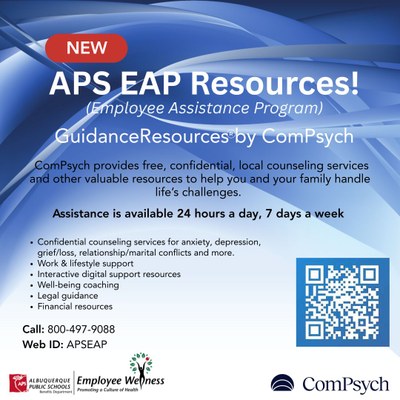
We are pleased to announce ComPsych GuidanceResources® as the new provider of the APS Employee Assistance Program (EAP). ComPsych provides free, confidential, in-person and virtual counseling services, well-being coaching, and other valuable resources to help you and your family members handle life’s challenges, big or small. Assistance is available 24 hours a day, 7 days a week. Discover the expanded resources available to you and your family members through ComPsych.
To access ComPsych GuidanceResource® services:
- Call the toll-free number at (800) 497-9088. You'll be connected with a highly trained professional who can guide you to the appropriate services.
- Register with GuidanceResources® online at www.guidanceresources.com and enter the APS company WebID: APSEAP
Download the GuidanceNow™ app for fast and easy access to all your ComPsych resources. Use the same APS WebID: APSEAP.
Grounded Energy for Employees & Students with Mindfulness & Meditation
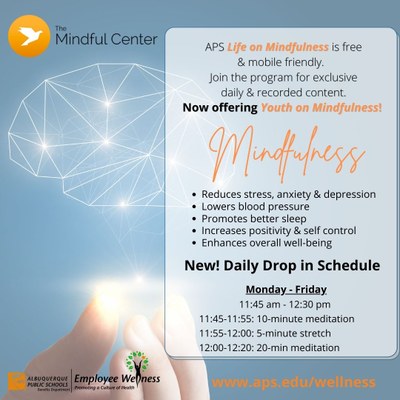
The APS Life on Mindfulness program, with Michelle Duval, offers a free, flexible platform for all APS Employees, the youth, and students in their lives. Nothing bolsters resilience, self-regulation, self-efficacy, and well-being like mindfulness!
The cool thing about this program is that we can practice it anytime, anywhere.
Have you checked out the new platform? It's mobile phone optimized, so you don't even need to worry about downloading another pesky app!
NEW LIVE SCHEDULE Monday - Friday
- 11:45-11:55 am: 10 min. meditation
- 11:55 - 12 pm: 5-minute stretch break
- 12-12:20 pm: 20 min. meditation
Feel free to join or leave at any time. According to the above schedule, Michelle begins the sessions at 11:45 a.m. and keeps things continuously flowing until 12:20 p.m.
Note: The same schedule and Zoom link apply Monday through Friday. The link is also conveniently located in the APS Employee Wellness event calendar.
To Log in:
- If you have not enrolled in the Life on Mindfulness program, enroll here.
- If you are enrolled, click this link: https://themindfulcenter.com/login and go to the top right, orange "member login" button.
- Enter the email that you registered with.
- Enter the new password: LOMPREMIUM
The site is 'mobile-ready,' meaning you can view and listen to meditations via your phone anytime, anywhere. Each week, new meditations become available, along with recordings of past meditations and featured workshops.
NEW! Youth on Mindfulness Page on the Life on Mindfulness Platform
Bring mindfulness to your students and add another Goal 4 skillset to your classroom! The Mindful Center has added a Youth on Mindfulness page. This is free for APS employees, and educators can use any meditations for classroom use. These meditations are suitable for students aged 10-18.
To get to the Youth page:
- Click on your Life on Mindfulness account.
- Go to the "Member login" top right orange button and log in.
- Click the top left menu "Life on Mindfulness".
- Scroll down to the "Meditate Now" button and click.
- Scroll through the audio options. All 18 audio meditations are age-appropriate.
Wellness Trends In The News
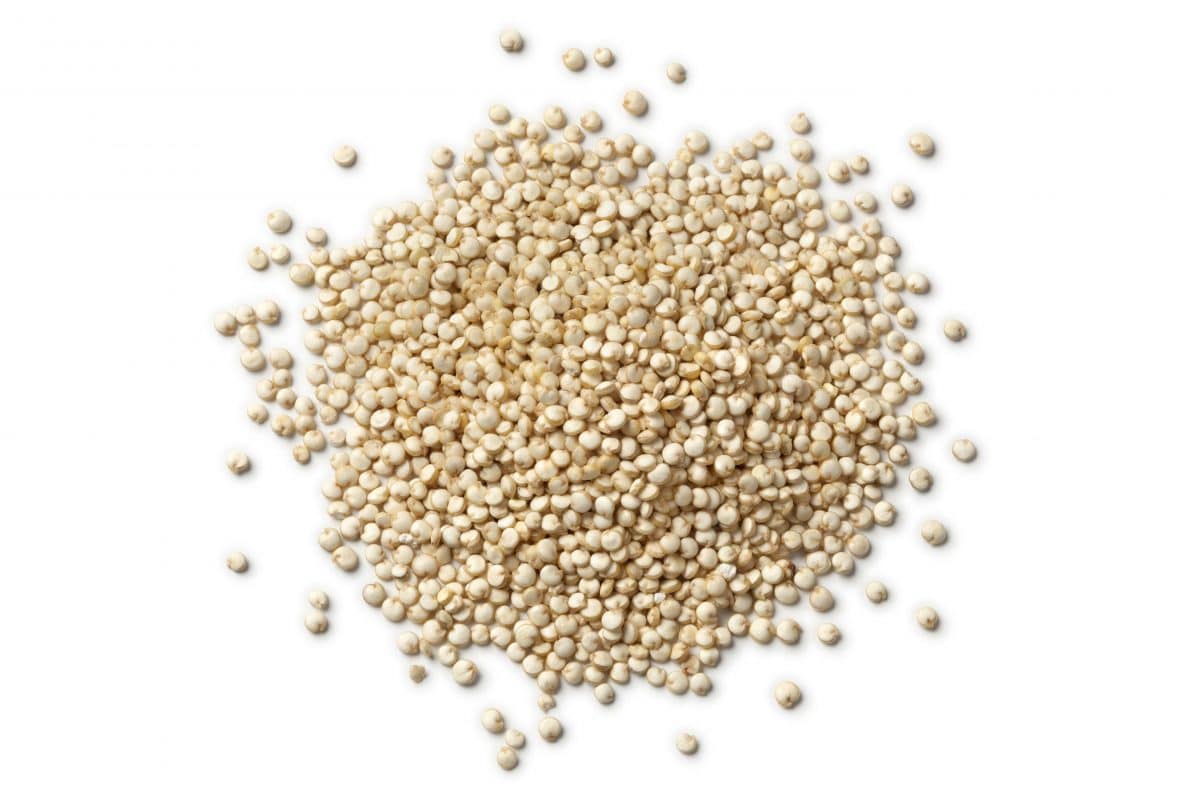 |
Feeling Blue? Eating More Fiber Could Help
Lifting your spirits might be as easy as adding more beans and other fiber-rich foods to your plate. A study published in the journal Nutrition in October 2018 found that people who reported eating the most fiber overall (including from cereal grains, vegetables and fruits) had fewer depressive symptoms. The data came from 16,807 American adults enrolled in the National Health and Nutrition Examination Survey (NHANES). |
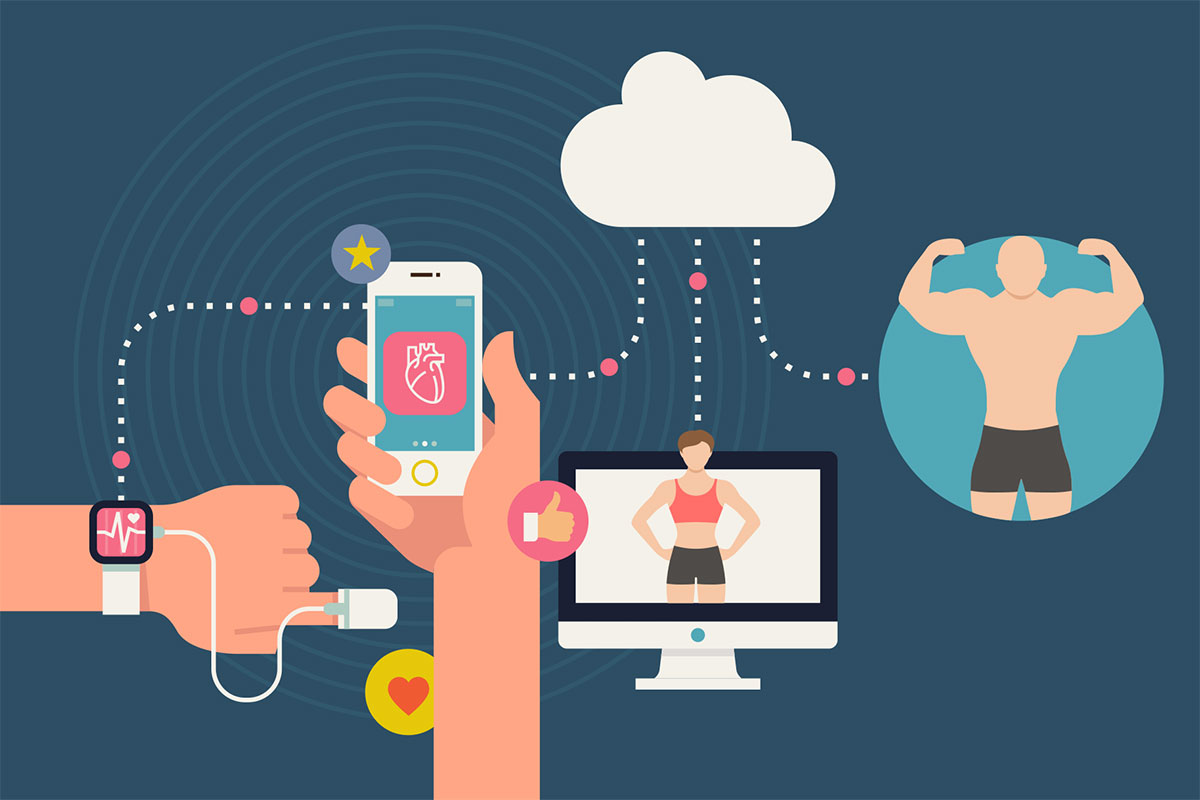 |
Top Fitness Trend in 2025?
In 2025, wearable fitness technology has officially taken center stage. Topping global fitness-related search trends, the topic now dominates not just consumer curiosity, but industry conversations, innovation pipelines, and user expectations. With smartwatches, fitness trackers, biometric apparel, and even AI-powered rings saturating the market, people are more interested than ever in how these devices can…read more » |
 |
Running Benefits for Brain Health
Investigators now have new insight into how running benefits brain health, movement and cognition by examining dopamine levels. |
 |
Recipe: Chili-Peach Gazpacho
People who regularly eat chili peppers may be 26% less likely to die of heart disease—which makes this chili-peach gazpacho recipe a hit. |
 |
Group Exercise May Help Older Adults Combat Loneliness
Group exercise not only boosts physical health but, for older adults, may also support mental well-being by reducing feelings of aloneness. |