 Albuquerque Public Schools
January 2026 Wellness Newsletter ✨ Building Generational Health
This is our year to build generational health. The difference between habits and behaviors, four ways to practice lifestyle iteration, and check out ComPsych's financial resources, wellness coaching options.
 Build Generational Health & Pivot From Poverty To Prosperity
Habits vs Behaviors
The previous Wellness Wire laid the foundation for our year to Build Generational Health in 2026. If you haven't had the chance, please click the link above for a deeper dive into these key points:
- Poverty is multi-faceted and includes generational, social & spiritual soul sickness. Many people are stuck not only in financial poverty, but also a meager mindset holding us down physically, emotionally, and spiritually.
- Denying the truth doesn’t change our reality.
- There are chemical processes in the brain being hijacked by the habenula that loot our drive for healthy lifestyle behaviors, pilfer productivity, and siphon our hope and happiness. The tiny habenula reaches into nearly every aspect of our psychology. Research has revealed its impact on everything from depression and anxiety to addiction and sleep.
- Understanding the neurochemical influences of the habenula adds deeper meaning, clarity, and awareness to behaviors that shape motivation, influencing perseverance, self-regulation, self-efficacy, and resilience.
- This awareness can help us achieve personal success measures.
- Pivoting from a performance-poverty-based mindset to an intentional, thrifting, iterative mindset helps us move into abundance and prosperity.
- SMART Goals can hijack the habenula, leading to a subtle, undetectable loss of motivation. Inserting interation and shifting our expectations at the start of the process can help keep the habenula regulated.
- Everything in life relates to the APS District's Goal #4, which is why it is the most critical component to collective well-being, long-term health, and happiness.
This week, let's reconsider one area of behavior change thinking that can elevate our motivation kill switch and failure detector - thereby activating the habenula. How we frame habits and setbacks.
Habits vs Behaviors
This time of year, millions of us are hopeful of successfully changing or adopting a habit or behavior. Habits and behaviors are often used interchangeably. I want to clarify the difference between the two.
Habits are actions we intentionally insert into our days. Hopefully, something positive that will enhance our well-being and reduce stress. Inserting the habit and maintaining it may become routine, but it's a thoughtful one. Behaviors are often subconscious. We do them without even really thinking about it. Behaviors are so ingrained in a routine that they become automatic.
We often refer to things as 'bad or good habits,' but in fact, we're referring to our behaviors.
Here are some examples:
- Nightly snacking while watching TV is a behavior - not a habit.
- Drinking 1-2 glasses of wine or beers every night while making dinner or watching TV is a behavior - not a habit.
- The daily stop to Starbucks, Dutch Bros, or Dunkin is a behavior - not a habit.
- Smoking or vaping is not a bad 'habit', it's a bad behavior. I rarely moralize a behavior as "good or bad" but in this case - there's really no question.
- Scrolling the internet or social media every morning or night, and losing 30 minutes to an hour of our day, is a behavior, not a habit.
Any action done pretty much daily and so entrenched in a person's routine that they don't really think about it is a behavior.
Of course, we have great, positive, healthy behaviors, too. That's what many of us strive for and accomplish. And I'm not trying to make anyone feel guilt or shame about their behaviors - I have fallen victim to behaviors that rob my sleep, disrupt my peace, hijack my health, and elevate stress- just like everyone else. We are all human, so no judgment.
But again, denying the truth doesn't change the reality.
This is the time of year when many see ads touting a 10-day detox, 21 or 30 days to "build better habits." While scientific evidence supports the idea that short-term habits can initiate change, solidifying new behaviors typically takes much longer than the common "21-day" myth.
For deep, enduring neural changes, researchers often point to a period of 3–12 months or longer to fully rewire the brain, particularly for complex behaviors or recovery from addiction.
Since we're still in the golden glow of January, I know there are a lot of us out there working on establishing better habits. My hope is that you'll commit to changing behaviors - because that's what lasts.
To do that, it helps to understand how the brain forms or reforms pathways that enable behavior change. It's called neuroplasticity.
Neuroplasticity is defined as "the brain's ability to change and adapt. It is caused by intrinsic and extrinsic motivation, like learning new skills, experiencing new environments, physical exercise, sleep, and social interaction, leading to the creation of new neural pathways (synapses) or strengthening existing ones, a dynamic process that occurs throughout life but is most rapid in childhood. Key drivers include behavioral changes, environmental inputs, and repetition, all of which prompt the nervous system to reorganize its structure and functions."
Habits alone, for a short time, aren't enough to change the brain's neuroplasticity, which solidifies synapses to make something ingrained and automatic.
To actually build or rewire the neuropathways to make an action a subconscious behavior, we have to give our brains enough time to fortify those myelin connections and make them stick. Remember, a habit is intentional, and it takes a while for it to become so routine that we don't even think about it. So when we've had a stressful day, and our brain gets hijacked by the habenula, flagging our motivation kill switch or failure detector, we go into self-preservation mode - and subconsciously decide not to try, not to go to the gym, or pick up that hobby we've been struggling to recapture. Couple that stressful day with the habenula 'craving controller' and we get a double whammy of low motivation and a self-sabotaging call to eat, drink, or scroll the very things we've been trying to control.
The important thing to remember when that happens is: you're not a failure.
Habits are easier to break than behaviors.
We owe it to ourselves to acknowledge that fact so we can right-size expectations without feeling like we've failed, because the 10-day detox or 30-day quick fix didn't stick past day 11 or 31. These short-term marketing gimmicks lead to disappointment, frustration, and an overall quitting on the basic, simple, steady wellness practices that have a greater impact on our health over time than anything else.
Whether we want to quit a behavior that is wrecking our health or build a new one to enhance our well-being, it's going to take time and an iterative mindset.
Neuroplasticity involves the brain's ability to rewire itself, which is both what is referred to as synaptic pruning (weakening unhealthy connections) and myelination (strengthening useful ones) to reshape habits, allowing us to let go of 'bad' behaviors by stopping their repetition and building better, more healthful behaviors with consistent new actions, making those positive pathways more automatic. That doesn't mean the unhealthy behavior we're trying to let go of won't creep up ever again.
It's called a setback, and we all have them.
So, yes, habits can be great, but only when they are consistent with thoughtful iteration and positive reframing of setbacks do habits become the building blocks to lasting behavior change. We want to avoid the extreme "all-or-nothing" mindset some of these habit-based programs put us in. We will always have setbacks. When we experience those, our habenula releases that motivation kill switch and failure detector, snowballing our thoughts into feelings of failure and low self-efficacy.
Many of us view setbacks as failure.
Because extremes are cognitively cheap and make it easier to quit. Believe it or not, it reduces our decision fatigue if we frame something too strictly, and we already have a day of decision after decision. When we are tired, stressed, and have a long day, our brain makes it easy for us to drop out.
To keep our motivation kill switch and failure detector at bay, here are four ways to practice more iteration in your lifestyle behavior change approach:
1) Define a minimum (not a maximum). Your plan needs a realistic floor you can hit on your worst day: maybe that’s 15 minutes of walking, one real whole-food meal, in bed by eleven versus midnight, set a timer for 10 minutes of news scrolling, etc. But give yourself grace and space to hit a minimum, and you'll feel more successful. Does the minimum become your new normal? No, but minimums keep us moving forward. They give you an iteration so you feel successful and stay motivated on your busiest of days.
2) Pre-plan your “setback & stressed-out strategy.” Write it down ahead of time (perhaps in your weekly planning):
- “If I miss a workout, I do the 10-minute version or add 5 minute micro-moves throughout the day.”
- "If I slip and eat a fast food meal, too much sugar/soda pop, processed foods, (whatever it is), I will stay on track and be consistent with my next meal, adding vegetables/healthy whole foods, etc."
- I will identify the trigger that caused the setback and how to work around it next time. Ex. Stress eating: take a walk or do a stretch break, have healthier snacks on hand, stay away from environments with sugary baked goods (break rooms, staff lounges), and make sure meals are satisfying enough to avoid 'hangry' situations.
This protects self-efficacy, keeps the habenula regulated, the very thing that setbacks tend to damage.
3) Trade rules for ranges. Instead of a “never” or “always” poverty mindset, use “most days” or “2-3 times/week.” Ranges keep us feeling successful about our approach and in the game.
4) Reduce the need for willpower. If your plan depends on motivation showing up every day, it’s fragile by design. Want to go to the gym in the morning? Sign up for a workout class with an accountability buddy. Feeling sluggish in the morning - so it's hard to meet said buddy? Go to bed earlier. Want to eat or drink healthier at night? Make better choices at the grocery store and stop buying the food or drinks you are trying to cut back.
Our environment plays a big role in willpower management - change your environment, avoid situations and places that require it when you are stressed, and ease decision fatigue.
Strive for foundation building versus perfection. This flexible structure builds consistency, and consistency builds trust and confidence in our ability, which in turn fosters self-efficacy and a positive, abundant mindset.
- This repetition, even in modified forms, is also the main highway that builds neuroplasticity in our brains.
This practice is a more nuanced “growth mindset,” a flexible, experimental approach to change that views setbacks as learning opportunities to adjust and refine actions continuously, fostering persistence and sustainable behavior formation through small, consistent tweaks and 'test-and-learn' cycles. It also completely changes our approach and intentions - how we start, thrift, and frame the desired action - is the key!
Remember, an iterative mindset uses:
- Failure as an opportunity to learn
- Experimentation over perfection
- Develops persistence & resilience
The iterative approach starts with simplicity:
- Practice: Trying a new behavior or action
- Assess: Observe what works, what didn’t, and reframe.
- Iterate: Make small adjustments to improve the practice.
Benefits
- Builds lasting habits by moving away from willpower-based approaches that often fail.
- Increasing self-efficacy because it fosters a sense of control and confidence over the outcomes.
- Promotes inventiveness and encourages creative problem-solving.
- Reduces failure anxiety, thereby protecting against quitting by making every attempt a move forward.
My encouragement to you this week, as we flow into February, is to pick one of these areas and simply iterate on it. Release the expectation of 'perfect' and embrace a consistent approach. If you want guidance along the way, APS offers several wellness coaching resources and an amazing Life on Mindfulness program for adults and youth, free for all APS employees. Scroll below to learn more.
ComPsych Financial Guidance Resources

If financial security, taxes, budgeting, or getting a handle on credit card debt is on your New Year's goal list, ComPsych offers highly trained financial experts. Call the toll-free number, and you'll be connected to a consultant who will discuss your specific situation and schedule a phone appointment with one of their financial experts. This service is free for all APS employees and family members.
Consultation services include:
- Credit card and debt management
- Budgeting, retirement, and estate planning
- Mortgages, loans, and refinancing
- Tax and real estate questions
- Financing for college
To access ComPsych GuidanceResource® services:
- Call the toll-free number at (800) 497-9088. You'll be connected with a highly trained professional who can guide you to the appropriate services.
- Register with GuidanceResources® online at www.guidanceresources.com and enter the APS company WebID: APSEAP
- Choose the role group that most closely aligns with your position at APS. For family members, choose the APS employee role group. Your designation (ie, spouse, child) will be captured later.
- Download the GuidanceNow™ app for fast and easy access to all your ComPsych resources. Use the same APS WebID: APSEAP.
APS Offers Wellness Coaching for All Employees
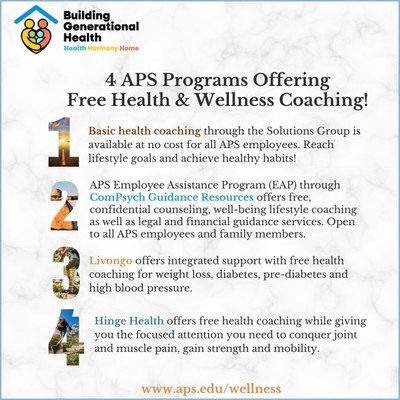
If new year motivation has you stuck with how to get started and stay engaged, wellness coaching is the perfect avenue to redirect, reflect, and reset! Try one of these APS programs that offer personalized health coaching and enroll today.
- Health Coaching: This service is offered through our Solutions Group wellness partner. Get help shifting lifestyle habits, managing a chronic illness, weight loss to improve health, or simply feel better. APS offers free Health Coaching for all employees. *Open to all APS employees.
- APS EAP free, confidential counseling and lifestyle/well-being coaching services through ComPsych Guidance Resources as well as financial and legal guidance services. *This is open to all APS employees and immediate family members.
- Livongo/Teladoc is an integrated program for diabetes, high blood pressure, pre-diabetes, and weight loss. Livongo offers wrap-around, integrated mental health services and health coaching. *This program is open to all eligible employees and dependents covered under APS Benefits. Getting started is easy!
- Text “GO APS” to 85240 to learn more and join
- Join by visiting https://www.livongo.com/aps.
- Call 800-945-4355 and use the registration code: APS
- Hinge Health: Get the relief you need to feel and function better with this virtual physical therapy program by Hinge Health. Hinge Health gives you the tools you need to conquer joint and muscle pain, including back, neck, knee, and shoulder pain, recover from injuries, prepare for surgery, and stay healthy and pain-free. Hinge Health also offers a one-of-a-kind, industry-leading women's pelvic floor program.
Click here and learn more to register. Begin your journey today with a team of physical therapists and health coaches! *Hinge Health is available at no cost to employees covered under the APS Benefits plans and eligible dependents.
Mindfulness - Our Safe Harbor to Help Regulate the Habenula
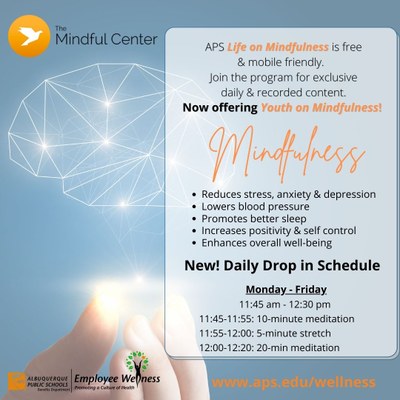
If there is one practice that is scientifically proven to help regulate our stress, shift our thinking from poverty to prosperity, and reframe setbacks as opportunities for positive behavior change, it's mindfulness. Meditation also directly impacts neuroplasticity for behavior modification and regulates our habenula to keep our neurochemical reward system running smoothly.
This is a free, flexible program for all employees that offers daily drop-in meditations, new weekly and monthly content, and featured meditations. See the link below to enroll in the Life on Mindfulness program for all content and email reminders. Everything is recorded for on-demand access. Links for daily drop-ins are available in the Employee Wellness Google Calendar. This site is mobile-optimized, so you can access a wide variety of recorded meditations anytime, anywhere. *The Life on Mindfulness program is open to all APS employees.
The mindful center has a new page and a new daily schedule. This allows you the opportunity to flex meditation times and enjoy a stretch break.
New login information for Life on Mindfulness
- If you have not enrolled in the Life on Mindfulness program, enroll here.
- If you are enrolled, click this link: https://themindfulcenter.com/login/ and go to the top right, orange "member login" button.
- Enter the email that you registered with. You can click the 'remember me' button for quicker access moving forward.
- Enter the new password: LOMPREMIUM
The site is 'mobile-ready,' meaning you can view and listen to meditations anytime, anywhere on your phone. Each week, there are new meditations, recorded past meditations, featured workshops, and meditations
NEW! Youth on Mindfulness Page on the Life on Mindfulness Platform
Bring mindfulness to your students and add another Goal 4 skillset to your classroom! The Mindful Center has added a Youth on Mindfulness page. This is free for APS employees, and educators can use any of the meditations in the classroom. These mediations are suitable for students aged 10-18.
To get to the Youth Meditations:
- Click on your Life on Mindfulness account.
- Go to the "Member Login" top right orange button and log in.
- Click the top left menu "Life on Mindfulness".
- Scroll down to the "Meditate Now" button and click.
- Scroll through the audio options. All 18 audio meditations are age-appropriate.
- Note: Additional youth content is regularly updated under the "Youth on Mindfulness" tab.
Wellness Trends In The News
 |
Recipe for Health: Awesome Turkey Chili
Take the guesswork out of fast, weeknight cooking by combining beloved convenience ingredients from U.S. specialty grocer Trader Joe’s with fresh ingredients and ingenuity but you can find these ingredients anywhere. Give yourself a break—and a hearty nutritional boost—with this slow-cooker chili dinner. |
 |
Cold-Weather Clothing Training Impact
State-of-the-art cold-weather protective clothing adds a metabolic cost from the extra weight, independent of thermal effects, and you may not need bulk to optimize comfort and warmth. read more » |
 |
Brain Fitness and Cardio Training
Research identifies brain dopaminergic function as the probable means by which aerobic activity stimulates growth and improves brain fitness. read more » |
 |
Does Lifting Weights Lower Blood Pressure?
Resistance training does much more than build strong muscles and bones, but does lifting weights lower blood pressure, too? read more » |
 |
Benefits of Yoga for the Immune System
Can you use yoga for the immune system? Research shows it may have beneficial effects on inflammatory markers and cortisol levels. read more » |