 Albuquerque Public Schools
Where Learning Takes Root
The Los Padillas Wildlife Sanctuary continues to welcome every APS third grader for hands-on, place-based learning that connects science, culture and community.
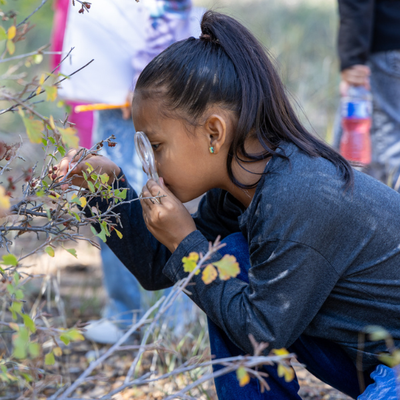
A group of third graders from Hawthorne Elementary crouched near a plant, examined it with a magnifying glass and sketched it in their notebooks. Around them, the cottonwoods of the South Valley swayed gently, and the voices of educators guided quiet discoveries. It was another busy morning at the Los Padillas Wildlife Sanctuary, a unique outdoor classroom on the Los Padillas Elementary School campus that has become a signature experience for many.
“The Los Padillas Wildlife Sanctuary is a hidden gem within APS, a living outdoor classroom where all third graders across the district experience hands-on, place-based learning connected to our local environment, wildlife and cultural heritage,” said Monie Corona, environmental education resource teacher with the APS Indian Education Department and the Los Padillas Wildlife Sanctuary.
“Students explore habitats, identify native plants and animals and learn how people connect to the land through stories and science. It’s been incredible to see their curiosity and joy come alive outdoors.”
Bringing Learning to Life
The third-grade field experience, now in its fourth year, integrates science and social studies through a 3.5-hour hands-on visit. Students explore habitats, learn about local wildlife and discover how ecological systems work—all while developing a deeper connection to the Albuquerque bosque and their community.
“I have been to the Los Padillas Wildlife Sanctuary many times,” said Crystal Hall, a third-grade teacher at Hawthorne Elementary. “Each visit is unique because the guides tailor the experience to the needs of the students. They do a wonderful job encouraging exploration and curiosity.”
Hall said the visit has a powerful and lasting impact on her students, and that the trip brings classroom lessons to life.
“In class, we read and study about nature, habitats and ecosystems, but seeing these concepts come to life at the sanctuary truly solidifies their learning,” she explained. “Experiences outside of the classroom help students make real-world connections. Many say it’s one of their favorite experiences of the year.”
Connecting Community and Culture
Community partners play a significant role in the sanctuary’s success. Charlie Ciernia, a resource teacher at the sanctuary, said, “We have a lot of community partners and neighbors that come to do guest speaking and storytelling. It's nice to get the community involved.”
One recent guest was Sara Keeney, former principal of Los Padillas Elementary. She spoke to students about native plants, sharing real seed and plant samples and asking them to use their observation and logic skills to determine where these plants might come from or how they might grow.
“I love the Wildlife Sanctuary. It’s such a great program, and I’m just thrilled that APS is taking it on as something to offer all the kids,” she said. “I always had a passion for plants, but I could only really indulge it after I retired. I hope they all go back and try to experiment, planting with their seeds.”
Outdoor Learning for All
For Corona, outdoor education is more than a field trip, it’s a philosophy of learning that removes barriers and builds belonging.
“So many kids have barriers to outdoor spaces,” she said. “You don’t need a sanctuary to make it an outdoor place. Outdoor learning can really take place anywhere. You can tie it to all the curriculum that you’re doing.”
She shared an example that captured the heart of the sanctuary’s mission.
“I think about a child last week that Mr. Charlie had, and she told him at the end of the day—and this is the greatest compliment we can ever get—she said, ‘I had the best day ever.’ Her reason was because she got to look at plants up close. She’d never looked at plants up close. I thought, wow. Maybe that child will be a botanist someday.”
The sanctuary also emphasizes cultural relevance in its lessons, ensuring that every student can see themselves reflected in what they learn. This approach aligns with the principles of the Yazzie-Martinez case, a landmark ruling that called on New Mexico schools to provide culturally and linguistically responsive education for all students.
Corona explained that this commitment guides much of the work at the sanctuary.
“We try to make sure that we are touching on both the Yazzie and Martinez sides so that kids see themselves in the curriculum we’re doing,” she said. “That was a huge part of Yazzie-Martinez, that the curriculum we teach represents the student population. I feel like here at the sanctuary, we meet those goals. And that’s important to me.”
At the sanctuary, lessons intentionally weave together science, culture and identity. Students explore native plants that have been part of local traditions for generations, learn stories tied to the land and discuss how different cultures understand and interact with nature. These place-based lessons not only deepen students’ academic understanding but also help them develop pride in their heritage and respect for the diverse cultures that shape New Mexico.
Get Involved: Community Workday at the Los Padillas Wildlife Sanctuary
Join the APS community for a Los Padillas Wildlife Sanctuary Community Workday on Saturday, Nov. 8, to help care for this beloved learning space. Sign up here.
Shifts:
- 9–11 a.m.
- 11 a.m.–1 p.m.
- 1–3 p.m.
What to Bring:
Hat, gloves, sunscreen, water bottle and a snack to share!
Activities include:
Weeding and habitat care, pond maintenance and removing invasive species.
To learn more about the Los Padillas Wildlife Sanctuary, visit our website.