 Albuquerque Public Schools
Keeping Cool: APS Works to Beat the Heat in Classrooms
Facts, Challenges and Solutions.
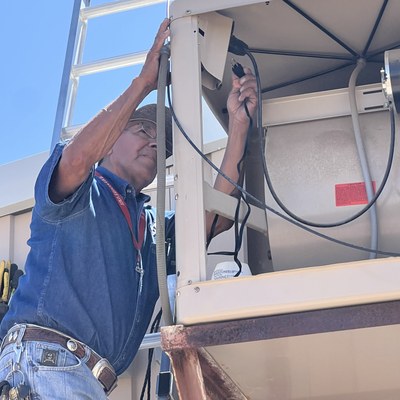
Throughout the summer, Albuquerque Public Schools HVAC technicians and contractors have been busy servicing air conditioners and evaporative coolers at schools across the city so classrooms can be as comfortable as possible when students return.
It’s a monumental task, given that APS has 153 schools and office buildings totaling 19 million square feet. Keeping those spaces comfortable requires more than 20,000 evaporative and refrigerated air cooling units.
Here’s a look at some of the challenges that come with keeping these spaces comfortable and what APS is planning longterm to improve the situation.
APS by the numbers
153: Schools and office buildings
19 million: Square footage of all district facilities
20,000+: Cooling units, including evaporative and refrigerated air
$51,000: The amount the district spends every day on electricity.
72: The percentage of square footage at schools cooled with evaporative coolers
$165 million-$175 million: Rough estimate of the cost of converting all learning spaces at APS to refrigerated air.
$40.2 million: The amount the district is seeking in the November bond election to convert 20 schools to refrigerated air.
Q&A
What work has been done over the summer to ensure APS cooling systems are working properly when students return to school?
APS technicians have been working since May, servicing evaporative coolers and replacing cooling pads and servicing and testing HVAC units to pre-empt problems for the new school year. Contractors also replaced evaporative coolers with refrigerated air units at most of the Bel-Air portables and at Coronado Dual Language Magnet School’s new campus.
Can you guarantee classrooms won’t be hot when the new school year begins on Aug. 7?
Unfortunately, we can’t guarantee that. Only about 28% of our classrooms have refrigerated air, meaning the remaining 72% are serviced by evaporative coolers. Evaporative coolers are not as effective in extreme temperatures or when it’s humid outside. At best, evaporative coolers can reduce temperatures by 20 degrees, which means that on a 100-degree day, the best you’re going to get inside that classroom is 80 degrees. And when you add a teacher and 20 students, that classroom is going to get hotter than 80 degrees.
If evaporative coolers aren’t very effective, why do we have them?
Most APS schools were built 50 or more years ago when evaporative coolers were the standard for Albuquerque. At the time, evaporative coolers did a good job of cooling down classrooms with the added benefit that they used a fraction of the electricity that refrigerated air units used. But as temperatures in Albuquerque have risen, evaporative coolers have become less effective.
So why not just replace all APS evaporative coolers with refrigerated air units?
Cost and the sheer scope of the project. A rough estimate is that it would cost APS between $165 million and $175 million to convert all classrooms, libraries and other learning spaces. Converting a school from evaporative cooling to refrigerated air is a complicated process that involves not only replacing the units themselves but also installing ductwork. In many cases it can even require upgrading electrical systems, replacing some roofs and windows, and reinsulating a building. In other words, replacing evaporative cooling can sometimes be a construction project unto itself.
Does that mean APS is just stuck with evaporative coolers that don’t do a very good job?
Not at all. While we can’t convert our schools all at once, we recognize that hot classrooms interfere with learning. We know we need to provide students and teachers with good learning environments and that, given the steady rise in temperatures in recent years, refrigerated air in our classrooms is a necessity. Refrigerated air conditioning is now the standard for all new APS construction projects, and we are committed to moving to refrigerated air at our other schools as funding becomes available. Toward that end, we are asking voters to consider a General Obligation Bond this November that would, among other things, provide $40.2 million to convert 20 schools to refrigerated air.
If voters approve the bond, which schools would be converted?
The schools are:
- New Futures High School
- Mary Ann Binford Elementary
- Barcelona Elementary
- Reginald Chavez Elementary
- Dennis Chavez Elementary
- Chamiza Elementary
- Tomasita Elementary
- Edmund G. Ross Elementary
- Kit Carson Elementary
- Apache Elementary
- Pajarito Elementary
- Chaparral Elementary
- Double Eagle Elementary
- Hubert Humphrey Elementary
- Painted Sky Elementary
- Desert Ridge Middle
- Eisenhower Middle
- Grant Middle
- Washington Middle
- And Hayes Middle
How were those 20 schools selected for the cooling unit upgrades?
Technical evaluations were conducted on several factors, including the age and condition of existing systems at each of the schools and their effectiveness. Another key factor considered was the ease of converting the existing system to refrigerated air – including ductwork, electrical, insulation, etc. New Futures has to be done due to the population it serves and the required standards for day care.
At the beginning of last school year, there were lots of complaints about cooling units not working properly. Can you explain what happened and if we’re likely to see that again this year?
We did have some cooling units malfunction last year and they were repaired as soon as possible. Given that we have more than 20,000 units across APS, it’s not surprising there would be some issues. But most of the hot classroom complaints we received last year involved evaporative cooling units that were operating exactly as they were designed but were not able to produce comfortable room temperatures because of the extreme heat outside and humidity. In some cases, schools moved children from hot classrooms to areas that were cooler.
What, if anything, can APS do if a cooling unit truly goes down?
We handle those situations in various ways. Sometimes, we can move affected classes to other parts of the school where cooling units are working. We also have portable refrigerated air units that we can bring in while the problem is being addressed.
Is APS able to address cooling problems quickly?
Our technicians and contractors strive to resolve AC issues quickly, but response times vary with service demand and parts availability. We work with certified licensed contractors so classrooms are served more quickly.
With all of the complaints about hot classrooms in August, did APS consider pushing the start of the school year later?
Yes, APS did consider that. We asked our families and staff for their preferences on an early August start and May finish, or starting and finishing the school year later. The vast majority of the more than 13,000 people who took the survey preferred the early August start and May finish. District leaders went with the preference of the majority.
You noted temperatures in Albuquerque are getting hotter. Is this an anomaly, or is it something we should get used to?
Unfortunately, the hotter temperatures appear to be here for good. According to Climate Check, a reputable website focused on climate risk assessments, in a typical year around 1990, Albuquerque experienced about seven days above 97ºF in a year. By 2050, we’re projected to experience an average of about 45 days per year over 97º.