 Albuquerque Public Schools
A New Kind of Support: La Cueva's Bear Success Center Redefines Student Success
The Bear Success Center is helping LCHS students stay connected, supported and in school with attendance rising and suspensions dropping.
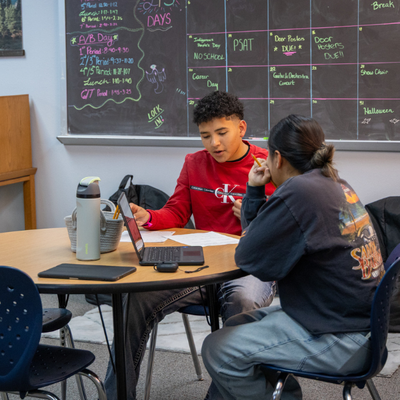
The hum of soft music can be heard in the hallway outside La Cueva High School’s English wing. Inside, warm lighting, colorful bear artwork and welcoming signs greet students as they enter the Bear Success Center—a cozy space designed to calm, connect and support. There are quiet corners, tables for tutoring and desks for make-up tests. It feels less like a space for consequences and more like a space for connection.
That’s intentional.
“When you look at these rooms being in the center of campus, they’re not walking by my office or the assistant principal’s office,” LCHS Principal Darrell Garcia said. “We purposely decoupled this from that. This team is truly creating a place for the kids to come to because it’s part of where they feel safe and where they need to be.”
The Bear Success Center opened this school year as a new approach to student support rooted in connection, not punishment. Instead of sending students home or isolating them when challenges arise, the center offers behavior redirection, tutoring, test make-ups and emotional support. The results have been immediate: attendance is up, suspensions are down and repeat offenses have dropped significantly.
“We’ve heard feedback for a while from our teachers about what’s missing,” Garcia said. “So we started looking at discipline and behavioral supports not as isolated issues, but as part of a larger system of student success. You can deal with behavior through consequences, but we know that discipline doesn’t necessarily change behaviors. Or you can say, let us get to know you, let us figure this out and start getting you to the right places. That’s where this idea came from.”
Over the summer, a dedicated team of La Cueva staff came together to design the Bear Success Center as a new kind of support system for students. The group includes Resource Teacher Celeste Turrietta, Dean of Students Trey Saxon, Crossroads Counselor Christine Loidolt and Assistant Principal of Student Success Melanie Tapia, along with others who share a passion for helping students thrive. Each brings a unique focus, from academics and restorative practices to social-emotional learning and student connection, creating a space built around care, collaboration and belonging.
“In addition to the academics and that support, we’re really focused as a team on supporting the SEL, the mental health piece,” Loidolt said. “It’s not that you’re in trouble. It’s, how can we help you? What’s going on? Maybe you didn’t get breakfast, maybe your parents are divorcing, maybe you hate math. Let’s find out why and get you connected.”
That mindset shift—from consequence to care—is central to the Bear Success Center’s impact.
“We’ve done a really beautiful job of making sure this isn’t a negative place,” Loidolt added. “This isn’t where the bad kids are coming. We’ve got a really well-balanced group of kids, from our highest achieving students to those struggling, and they’re taking time to get to know each other in new ways.”
Those peer connections are intentional, too. Inspired by a college and career counselor’s observation that peer tutoring builds community and confidence, La Cueva reimagined its student aide roles into “peer tutor” and “peer helper” positions. Now, some of the school’s highest-achieving students support classmates who need extra help in the center or directly in classrooms.
“This success center has really ballooned into something even bigger than we thought,” Garcia said. “It’s now a destination for kids to come to if they need help and support.”
Assistant Principal Melanie Tapia agreed and said it’s an indicator that people are changing their viewpoints about this space's purpose.
“It isn’t the place where the bad kids go,” she said. “This is a place where kids are feeling comfortable because they’ve got us, and they’re able to come here and make those connections and feel supported. Our attendance is up, suspensions are down, and repeat offenders are way down.”
Restorative work plays a key role in that success, with restorative mediations regularly occurring in the space.
“The kids take accountability, they sit down with the teacher, and out of all the mediations we’ve done, only two didn’t work out the way they should have,” said Saxon. “All the others have been successful, no repeat behavior.”
Garcia added, “That’s engaging our teachers in the restorative work as well. Sometimes the conflict is between a student and teacher, and we’ve got to heal that, too. This team has done a phenomenal job of getting both sides to a place where they can move forward together.”
For teacher Celeste Turrietta, the difference is visible every day. Seniors stop by during off periods to study, talk or just recharge.
“We heard that seniors don’t feel connected because they have so few classes,” she said. “So we get a lot of them who stay and get support. We really focus on keeping them locked in and ready to graduate.”
Turrietta has also seen the restorative process transform how students and teachers relate to one another. Instead of having kids say, “I think my teacher doesn’t like me, I want to ditch,” she said the Bear Success Center brings them together.
“A lot of times, it’s just a miscommunication,” said added. “After the mediation, that kid feels better, and we circle back to ask, ‘How do you feel now? Do you need more support?’ It’s really, really good.”
Walking into the Bear Success Center, Garcia said, you can feel that difference immediately.
“Just walk into these spaces,” he said. “At most schools, you’ve got four white walls and a message of, ‘You’re here because you did this.’ Here, it’s warm, it’s inviting. I mean, I want to hang out in there. Environment matters, and how you approach kids matters. All of this connects to one thing: how we can support kids at every level.”
Saxon summed it up simply: “We want to make sure at the end of the day, it’s student success. We’ll keep adapting to meet their needs. The finish line will move, and we’ll move with it.”